Wednesday, February 22, 2012

Naming a mountain range

As a follow-up of my last blog and the comments I have received, these are the most common names used for parts of the ca. 2400 km long mountain range in Norway and Sweden.


Scandes: Used by some people in Sweden. It is also used by a few geologists (well, at least one) for the mountains formed during the Caledonian orogeny, about 410 million years ago.

The Scandinavian Mountains: I’m not sure if this is used as a descriptive term in Sweden, or as a proper name. It is not used in Norway as far as I know.

The Caledonides: The rocks of the current range were deformed (and partly formed) during the Caledonian orogeny, but the current topography is believed to be of an entirely different origin than the Caledonian range (at least by 99,9% of the geologists..).

Kjølen/Kjölen: Refers to the mountains along the border between Norway and Sweden, although many people think the name applies to the whole range. In my opinion, it doesn’t.


The Geological society of Norway has started the work on launching a name contest, and more info will follow soon, according to the society.

There are several independent initiatives as well:

http://www.norsk-klatring.no/Ute/Fjell/Fjellnavnekonkurranse

http://lydpoesi.wordpress.com/2012/02/05/alpane-uralfjella-pyreneane-og-fjellkjeda-utan-namn/

Thursday, February 16, 2012

On the discovery of a new 2400 km long mountain range

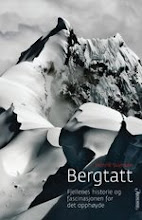
It may sound like a joke, but it’s true. If you don’t believe me, find an atlas or map and look up Scandinavia: A lot of elevated topography, but no name. I made the discovery when working on my new book Bergtatt (“In High Places”), about 3-4 years ago.


In Norway, there is a long mountain range stretching from the southern parts and all the way to arctic Finnmark County, but very few people have thought about it as representing a unified range. In addition, the range doesn’t have a name. Local and regional parts are named of course (like Jotunheimen and Rondane), but the range as a whole lacks a name. How is that possible?

A key reason is probably related to how Norwegians use the mountains. We go there a lot, either to private cabins or hiking, which puts the focus on specific areas and not an extended part of the range. And the mountain range is actually quite difficult to see from afar, in contrast to e.g., the Alps. There also used to be confusion about the relationship between the current mountains and the ca. 410 million year old Caledonian range which rocks are found in the very same mountains. Thus some called it the Caledonian range. Today we know that the mountains in Norway belong to a specific category of mountains that are present on passive margins, and mountain ranges of similar extent, altitude and origin are found around the globe (Brazil, South Africa, India, Australia, and Greenland).

In the 1940’s, the Swedish geographer Erik Ljungner suggested a name on the Swedish part of the range, the Scandes mountains. The reason was his like for short Alps-Andes-like names. Today, that name is commonly used in Sweden and by some Norwegian geologists as well, but is not a name that can easily be applied in Norway.

The geological society in Norway will launch a contest later this year, where Norwegians can have their say about what they think the mountain range should be named. There are already several independent suggestions around, and it will be exciting to follow the development. What about "The northern mountains"? 

Wednesday, October 12, 2011

The Mysterious Bible of Successful Science Outreach


Most people involved in science outreach may, from time to time, need advice about how to improve. Be it writing techniques, language skills or target groups. Indeed, there are many books you can consult on this topic. Still, the basic ideas, the very foundations of the article, are left for the author. At least that’s what I though until I found the book Encyclopaedia of Article Ideas on a second hand market recently. The book was written by Leslie V. Heald, and was published in 1946. With a small size and neutral blue cover, it didn’t make much of an impression. It smelled of ‘old book’ and appeared to have been left unopened for a number of years.  

I opened it, and realized that I had discovered a gem. The book turned out to be a register of ideas about what to write articles about. It really covered ground, spanning thematically from art to psychology, from homely affairs to the mysteries of science.

Instantaneously, I understood that with this book, I would be able to fill my blog with exceptional article for years to come. The possibilities seemed endless.

It cost less than two dollars. What a coup!

There are several ways to use the book. You can look up your favorite topic and get ideas about how to target the article. Or you can freely combine themes from different topics, and make totally new concepts. Heald presents an example of how this can be done, and launch the themes home/furniture and crime/swindle, and voila, we get an article about “Famous swindles in costly furniture”. Simple, but elegant.

I turned the pages and arrived at a theme closer to my own field of interest: Conflicts between Man and Nature. Here, the very key words were listed as: Strange, continual, senseless, when man was a hunted animal, man’s struggle to supremacy, fighting snakes, stopping runaway horses (famous examples).

This last point took me somewhat by surprise, as I didn’t immediately associate runaway horses with any struggle with Nature. But here the book showed its strengths, as I never would have come up with this idea myself. 

A few pages later I came across a section about scientists. This is inspiring, just read the following key ideas: Queer, great, lucky, poor, female, genius, famous, eccentric, tragic, rich, struggling, great british scientists. Heald goes on and elaborates on scientists and how to make great articles:

  • Scientists who stuck by their theories. Though others did not believe.
  • Genius by accident.
  • Scientists who died for knowledge.
  • They risked their lives for science.
  • They experimented on themselves.
  • Are scientists supermen?

As you see, Heald laid the table for a number of article-goodies. I won’t give you more examples – for obvious reasons – but I guess you have more than enough to get started. 

One final piece of advice. Leslie Heald emphasize the endless possibilities in adding the words ”mysterious” and ”strange” in the title of your latest piece. I can’t help to agree when he concludes that “the idea speaks for itself”.