Wednesday, September 19, 2012

The Melody of Science

"Two times during the last few weeks, my wife has been asked to write a song. A very specific song that is, a song for special occasions when a person is celebrated e.g. for a 50th birthday or a Confirmation. The way to produce songs of this type is to use keywords from a person’s life that one way or other sums up his/her main events and achievements, and to fit it into the melody lines of a familiar song – often a very simple and somewhat traditional melody. I’m sure this must be common tradition in other countries too."


"Let me summarize the main ingredients that were gathered for one of these songs: “Childhood friends, the parents’ house, boyfriends, school, marriage, kids, working at X, likes reading and picking berries”. When I saw this list, I couldn’t help thinking: Is that it? My wife is good at this stuff, but even she protested about the apparent dullness and ordinariness of the keywords. There must be more to a life than that. The question is what the keywords for the song about your life would look like."

Read the rest of the post at the Blogosphere of the European Association of Geochemistry.

Thursday, September 13, 2012

The Norwegian Mountain Literature Award 2012


My book Bergtatt ('In High Places') received the Norwegian Mountain Literature Award 2012 last weekend! The award to handed to me by the legendary Nils Faarlund during an event at the Litteraturhuset in Oslo, and included 10.000 NOK which I handed over to Gerda M. Pauler and the work that Autism Care Nepal do. Among the audience were famous climbers like Doug Scott and Aslak Aastorp.

Previous years' awards were given to: Knut B Lykken «Turglede med konger og kunstnere», Halvor Hagen «Toppturer i Romsdalen», Terje Kleiven «Dei gav oss ein arv», and «Troll Wall. The untold story of the British first ascent of Europe’s tallest Rock Face». Hurrungane Turlag and Mountain People are responsible for the award.


Photos: Marit Bakke


Monday, July 16, 2012

Read this if you plan fieldwork this summer

“You just know it when it’s time to leave the field and head for home. When the thought of one more day collecting rocks in the field is just too much to handle; when the mosquito bites feel like personal attacks and the homely daily routines appear in your mind as something heavenly: DVD’s, your favourite coffee, the bed of course, but most of all, the bathroom.”


In my first post on the new blog site for the European Association of Geochemistry (EAG), I write about the possible challenges of getting your fieldwork samples back home. If you are already in the field, do not despair but check out the continuation of the above quote. You find my EAG blog here.

Picture of me taking samples during an expedition to East Siberia in 2010.

Wednesday, February 22, 2012

Naming a mountain range

As a follow-up of my last blog and the comments I have received, these are the most common names used for parts of the ca. 2400 km long mountain range in Norway and Sweden.


Scandes: Used by some people in Sweden. It is also used by a few geologists (well, at least one) for the mountains formed during the Caledonian orogeny, about 410 million years ago.

The Scandinavian Mountains: I’m not sure if this is used as a descriptive term in Sweden, or as a proper name. It is not used in Norway as far as I know.

The Caledonides: The rocks of the current range were deformed (and partly formed) during the Caledonian orogeny, but the current topography is believed to be of an entirely different origin than the Caledonian range (at least by 99,9% of the geologists..).

Kjølen/Kjölen: Refers to the mountains along the border between Norway and Sweden, although many people think the name applies to the whole range. In my opinion, it doesn’t.


The Geological society of Norway has started the work on launching a name contest, and more info will follow soon, according to the society.

There are several independent initiatives as well:

http://www.norsk-klatring.no/Ute/Fjell/Fjellnavnekonkurranse

http://lydpoesi.wordpress.com/2012/02/05/alpane-uralfjella-pyreneane-og-fjellkjeda-utan-namn/

Thursday, February 16, 2012

On the discovery of a new 2400 km long mountain range

It may sound like a joke, but it’s true. If you don’t believe me, find an atlas or map and look up Scandinavia: A lot of elevated topography, but no name. I made the discovery when working on my new book Bergtatt (“In High Places”), about 3-4 years ago.


In Norway, there is a long mountain range stretching from the southern parts and all the way to arctic Finnmark County, but very few people have thought about it as representing a unified range. In addition, the range doesn’t have a name. Local and regional parts are named of course (like Jotunheimen and Rondane), but the range as a whole lacks a name. How is that possible?

A key reason is probably related to how Norwegians use the mountains. We go there a lot, either to private cabins or hiking, which puts the focus on specific areas and not an extended part of the range. And the mountain range is actually quite difficult to see from afar, in contrast to e.g., the Alps. There also used to be confusion about the relationship between the current mountains and the ca. 410 million year old Caledonian range which rocks are found in the very same mountains. Thus some called it the Caledonian range. Today we know that the mountains in Norway belong to a specific category of mountains that are present on passive margins, and mountain ranges of similar extent, altitude and origin are found around the globe (Brazil, South Africa, India, Australia, and Greenland).

In the 1940’s, the Swedish geographer Erik Ljungner suggested a name on the Swedish part of the range, the Scandes mountains. The reason was his like for short Alps-Andes-like names. Today, that name is commonly used in Sweden and by some Norwegian geologists as well, but is not a name that can easily be applied in Norway.

The geological society in Norway will launch a contest later this year, where Norwegians can have their say about what they think the mountain range should be named. There are already several independent suggestions around, and it will be exciting to follow the development. What about "The northern mountains"? 

Wednesday, October 12, 2011

The Mysterious Bible of Successful Science Outreach


Most people involved in science outreach may, from time to time, need advice about how to improve. Be it writing techniques, language skills or target groups. Indeed, there are many books you can consult on this topic. Still, the basic ideas, the very foundations of the article, are left for the author. At least that’s what I though until I found the book Encyclopaedia of Article Ideas on a second hand market recently. The book was written by Leslie V. Heald, and was published in 1946. With a small size and neutral blue cover, it didn’t make much of an impression. It smelled of ‘old book’ and appeared to have been left unopened for a number of years.  

I opened it, and realized that I had discovered a gem. The book turned out to be a register of ideas about what to write articles about. It really covered ground, spanning thematically from art to psychology, from homely affairs to the mysteries of science.

Instantaneously, I understood that with this book, I would be able to fill my blog with exceptional article for years to come. The possibilities seemed endless.

It cost less than two dollars. What a coup!

There are several ways to use the book. You can look up your favorite topic and get ideas about how to target the article. Or you can freely combine themes from different topics, and make totally new concepts. Heald presents an example of how this can be done, and launch the themes home/furniture and crime/swindle, and voila, we get an article about “Famous swindles in costly furniture”. Simple, but elegant.

I turned the pages and arrived at a theme closer to my own field of interest: Conflicts between Man and Nature. Here, the very key words were listed as: Strange, continual, senseless, when man was a hunted animal, man’s struggle to supremacy, fighting snakes, stopping runaway horses (famous examples).

This last point took me somewhat by surprise, as I didn’t immediately associate runaway horses with any struggle with Nature. But here the book showed its strengths, as I never would have come up with this idea myself. 

A few pages later I came across a section about scientists. This is inspiring, just read the following key ideas: Queer, great, lucky, poor, female, genius, famous, eccentric, tragic, rich, struggling, great british scientists. Heald goes on and elaborates on scientists and how to make great articles:

  • Scientists who stuck by their theories. Though others did not believe.
  • Genius by accident.
  • Scientists who died for knowledge.
  • They risked their lives for science.
  • They experimented on themselves.
  • Are scientists supermen?

As you see, Heald laid the table for a number of article-goodies. I won’t give you more examples – for obvious reasons – but I guess you have more than enough to get started. 

One final piece of advice. Leslie Heald emphasize the endless possibilities in adding the words ”mysterious” and ”strange” in the title of your latest piece. I can’t help to agree when he concludes that “the idea speaks for itself”.


Thursday, September 22, 2011

My new mountain book: Why it took five years


Five years after I started my most recent book project, the resulting book is out this week. Would I have done it again? Yes. Am I proud of the result? Yes. Title of the book? A History of Mountains. It is not written in a text-book style, but aimed at the general audience (perhaps best labeled 'creative non-fiction').

By investigating the history of science and the current understanding of the geology of mountains, I tell the story of mountains and what they mean to us. Why are some many people fascinated by them, what is it that we don’t know about mountains, and why are they sacred in many (or perhaps most) parts of the world? What is it that geologists actually know about their birth, evolution and decay? I also present my own experiences, how I got fascinated by mountains and what I saw in the Andes, the Alps, and the Scandinavian mountains during researching for the book. 

As I learnt a lot during the course of the book project, it seems natural to share the lessons with the readers of my blog. So, if you are planning on writing a book yourself, and would like to spend as long time as I did from start to publication, then follow my advices: 
  • After long days at work and after the kids (if you have any) are put to bed, open your laptop and start writing. Being tired is extremely inspiring.
  • Make sure you need to do excessive research, preferable somewhat outside your main field of competence. There is nothing like it.
  • Start writing as soon as possible, as the first chapter will be outdated when the last one is finished five years later.
  • Get in contact with a publisher as soon as you can, as a positive response will ensure that the project is stressed by strict deadlines.
  • If you still head for completion before five years, send the manuscript to colleagues for an informal review.
Being a spare-time non-fiction writer clearly has its challenges.

My remaining challenge: the book is published in the Norwegian, but it will hopefully be available in English at some stage.


(Book cover: Nevado Chopicalqui (6354 meter), Peru. Photo by Alexandre Buisse.)

Wednesday, August 17, 2011

Imaginary landscapes


I was thinking about The Big Expedition this summer. The fieldwork that takes you far out for weeks. Last year I headed for East Siberia. This year I stayed at home. But I spent a lot of time thinking about that expedition, the lasting impressions. I searched my digital images. The taiga, camp fires, things we talked about, wild rivers and dead calm lakes. Old lava flows as far as the eye could see, and the wetness of the inside of my shell jacked when walking steep hills. 


(http://www.flickr.com/photos/giuliasilvia/4136350562/)

The wonders of thinking about the past: The most important scenes have crystallized and the irrelevant are about to be forgotten. I remember the landscape of East Siberia as clearly as it was yesterday, but the feeling of the wind and the temperature (was it cold?) is gone. The exhaustive moments are soon gone too, polished away – a necessity for wanting to return. Next year. I’m sure. 

Despite the lack of expedition life this summer, I have still been to the field. About 100 kilometres south towards Kongsberg. A colleague and I have been making new paths along a gully in the Krekling area – where a famous study trilobite of Cambrian shale was undertaken in the 1870’s by W.C. Brøgger. The surrounding forest was dark and the rocks black. I left home in the morning and came back for dinner. This style of fieldwork clearly has it’s advantages. Logistics: simple. Equipment: little. Costs: small: Comfort: high. 

So why push it for bigger expeditions to remote areas? Is it the dream about discovering new areas? To enter the unknown? Or has it something to do with the geologists was of working, and the quest for rocks, mountains, and exposures that may answer your scientific questions? You go where your questions take you.

Tuesday, May 10, 2011

My son discovers a chain of mud volcanoes near our summer house in Sweden

This happened to me a few days ago on the dirt road leading to my summer house in Sweden. My son (age 3.5) was sitting on my shoulders and had ample time to pay attention to the details of the surrounding landscape, whereas I kept a steady gaze at the forest up front while concentrating on walking. As usual, he saw many interesting details along the road, like little pebbles or items resembling bugs or even frogs. All of a sudden, he cried out:

Son: Look, what is that?
Father: Hmm. What is this?... Wow... These are like small volcanoes, like mud volcanoes. I have seen then on many occasions during field trips!

I let him down and we got down on our knees for studying the phenomena. Layers and layers of mud flows originating from central vent made these miniature volcanoes. The biggest had a diameter of about 40 centimeters. Spectacular. I took out my camera and started photographing while urging my son to not mess with them using sticks or pebbles. We got more excited.

They look very similar the mud volcanoes of Azerbaijan, just smaller.

Father: Can you stand over there, so I can take a picture?
Son: Yes, but why are these here?
Father: It’s the melting of the ice in the ground, the last remnant of winter.
Son: (pokes around) not bad, now I have seen mud volcanoes!

So, that must have been the trigger for the volcanoes. I know that a big truck used this road the other day, thus loading the ground and creating overpressure. The first mud volcanoes in Sweden! I got more excited, counted the vents (more than 60), thought about excavating the whole thing, making a cross section, statistics, taking samples… I even saw a gas bubble in one of the vents. And the nicest thing of all: all the volcanoes were associated with linear fractures in the road. It’s like volcanoes growing in a rift zone.

Son: Mud volcanoes!

Time was up. We walked the 30 meters to our house and had lunch. 


Wednesday, March 23, 2011

After the disaster


It was huge. What more is there to say? Japan was prepared as the big one has been expected for a long time. Still, the M 9.0 earthquake and tsunami devastated the whole coast line. Natural disasters always strike out of the blue no matter how well prepared a country is. Total preparedness will never happen and zero vulnerability is a dream that will never come trough. This applies to Japan as it applies to a small scale natural disaster that struck western Norway a couple of days ago. Two people died in a snow and mud avalanche

Composite disaster are characterized by additional major hazards and disasters following the main trigger. In San Francisco in 1906 the fires that were started in the wake of the earthquake destroyed huge areas, as was the case in Tokyo after the 1923 Kanto earthquake. Almost half of Tokyo was destroyed by the flames. In addition, tsunamis are relatively common following major earthquakes below oceans, like in Asia in 2004, Chile 2010, or in Japan. What makes the current situation in Japan different is the possible consequences for the reconstruction if the nuclear disaster escalates.

I the mean time geologists try to understand the earthquakes and wait to see if the fault line that was active in 1923 can be reactivated. The activity in the main fault in the Japan Trench is still high, with more that 230 registered earthquakes the last week. Three earthquakes with M >6.4 occurred yesterday. 

 Earthquakes in Japan the last week. www.usgs.gov.

Cities always rebuild after major natural disasters, but it remains to be seen what will happen near the nuclear plants in Japan.

Wednesday, March 9, 2011

The nicest columnar joints ever?


The picture this week is from the beautiful village Saint-Flour located about 80 km south of Clermont-Ferrand in the Massif Central (France). You see a lava flow with spectacular columnar joints overlain by a massive flow unit (picture 1). Saint-Flour is built on top of these basaltic flows (picture 2) that once poured out of the volcanoes forming the Massif du Cantal. 


 Picture 1: The columns in Saint-Flour.


Picture 2: Saint-Flour.

The volcanism in the Massif Central is young and rather odd. The most recent eruptions took place some 4000 years ago. Why are there volcanoes in this area at all? Is it linked to the Alpine deformation or to crustal spreading in the Atlantic?  

The volcanoes in Massif Central are numerous, ranging from lava domes to cinder cones, maars, and stratovolcanoes. In the north, the spectacular Chaine des Puys contains a great number of cones and maars, and one of the cones is partly excavated (the Lemptégy volcano; picture 3) as a part of the Vulcania theme park. Is this the best place in the world to see the internal structuring of a volcano, with fumaroles deposits, scoria, feeder dikes and lava flows? 

 Picture 3: Inside the volcano on a veeery gloomy day.


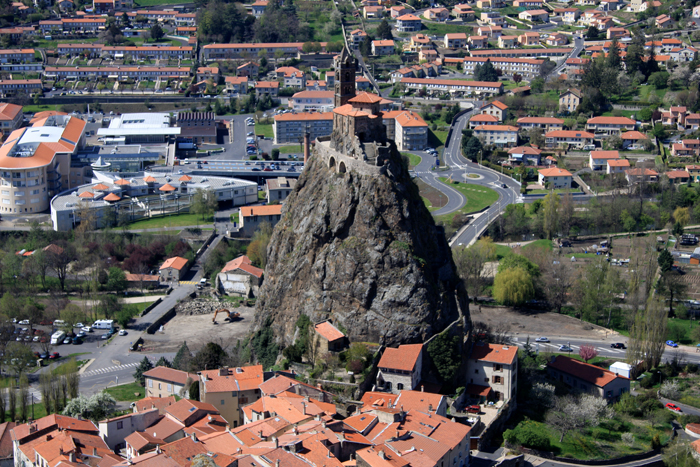
All of the prominent mountains in Massif Central are volcanic in origin, like the tallest one, Puy de Sanchy at 1885 m and Mont-Dore (picture 4). Further to the west, volcanic plugs dominate both the natural and cultural landscape (pictures 5 and 6).


 Picture 4: Mont-Dore in April/May.


Picture 5: One of the plugs in Puy-en-Velay. 


 Picture 6: Puy-en-Velay.


I wonder if the volcanoes will be brought back to life some day. Strictly speaking, they are only dormant.